Styling Guides
Halo Hair Extensions: A Stylist's Guide
Halo hair extensions add length and fullness in 60 seconds with no clips, glue, or damage. A Glendale stylist explains fit, blending, and care.
Halo Hair Extensions: A Stylist's Guide
If you want longer, fuller hair for a wedding on Saturday and your normal ponytail on Sunday, halo hair extensions are probably the most forgiving option on the menu. They clip nothing, glue nothing, and bead nothing to your own hair — the whole piece sits on an invisible wire that rests on your head like a headband. For clients who come into our hair salon in Glendale worried about damage, thin ends, or a stylist appointment every six weeks, this is usually the first thing I reach for.
Here's how halo extensions actually work, who they suit, and the honest trade-offs before you buy one.
What Are Halo Hair Extensions?
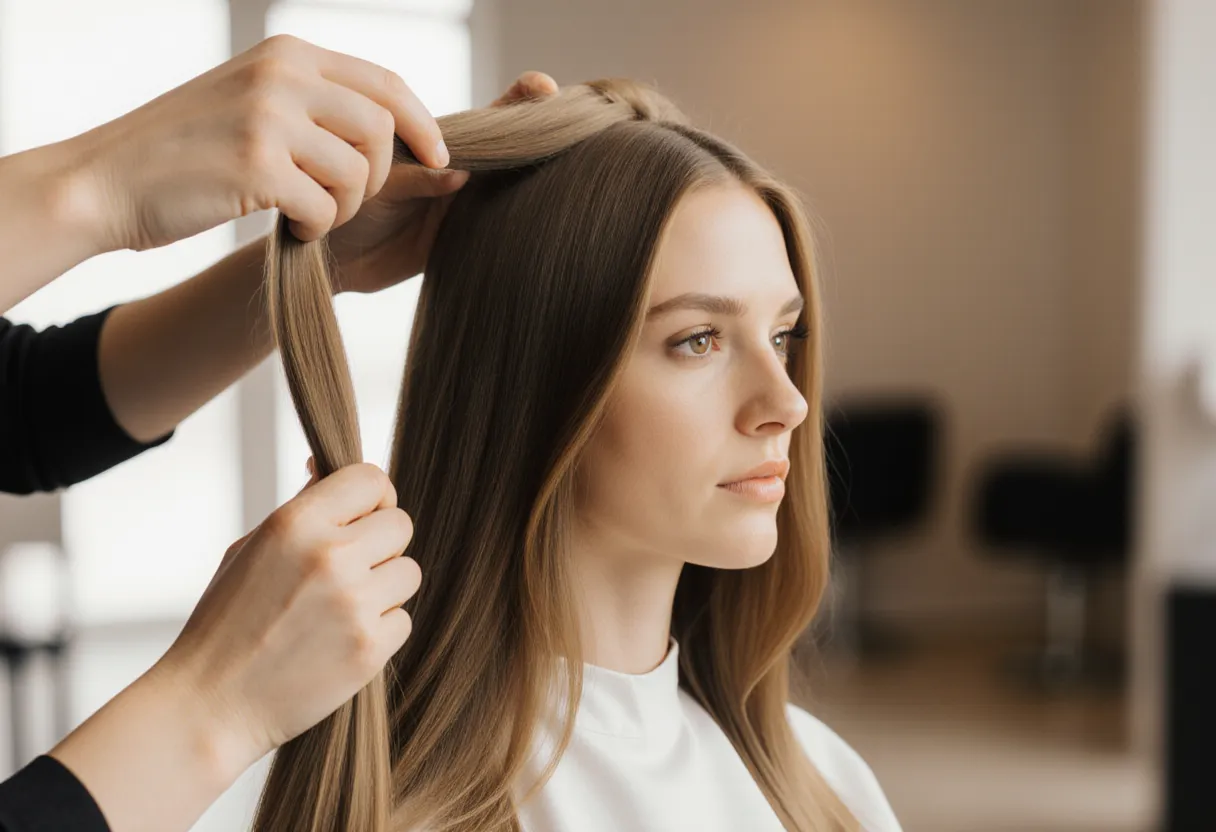
A halo is a single weft of hair — one continuous piece, usually 10 to 24 inches — attached to a clear, adjustable wire. You slide the wire over the crown of your head, sit it just behind the "halo" ridge where the top of your head starts to curve down, then pull your own hair over the top to hide it.
That's it. No heat, no adhesive, no tension on your roots. Some brands call it a halo weave or a hidden crown; it's the same construction.
Key things to know:
- Install time is about 60 seconds once you've practiced twice.
- The wire holds by tension, not by clipping into hair, so there's no pulling at the hairline.
- It comes out at night, every night. This is not a long-term install.
- Human hair halos can be curled, flat-ironed, and toned by your colorist. Synthetic ones cannot take real heat.
Halo vs. Salon-Installed Extensions
A halo is temporary and removable. Tape-ins, beads, and sewn wefts are semi-permanent methods a stylist installs and maintains every six to ten weeks. If you're weighing the full menu, our breakdown of the different types of hair extensions compares install time, cost, and upkeep side by side.
The short version: halos win on damage risk and flexibility. Salon methods win on security, seamlessness, and how they look in a high ponytail.
Who Halo Extensions Suit Best
I recommend halos most often to four kinds of clients.
- Event-only wearers. A bridesmaid, a graduation, a photo shoot, a trip. You want length for three days, not three months.
- Clients with fine or thinning hair. This is the big one — halo extensions for thin hair work because no weight hangs off individual strands. If beads or tape have slipped or caused shedding for you before, a halo removes that variable entirely.
- Anyone mid-color-correction or growing out damage. Zero added stress while your hair recovers.
- Budget-conscious clients. One good human hair halo runs roughly in the range of a single salon service, and it lasts a year or more with care.
Who it suits less well: very short hair. You need enough length on top — generally chin length or longer — to cover the wire. Below that, the wire shows and we'd look at clip-ins or a salon method instead.
Choosing the Right Halo: What Actually Matters
Most disappointing halos are the wrong spec, not a bad method. When clients bring one into the salon from Burbank or Eagle Rock and say it looks obviously fake, it's nearly always one of these four things.
1. Hair Quality
Look for 100% Remy human hair. Remy means the cuticles all run in the same direction, which is why it doesn't tangle into a mat at the nape after three wears. The best halo hair extensions are double-drawn, meaning the weft stays thick all the way to the ends instead of tapering into wisps.
2. Weight
Halos are sold by grams: roughly 100g–120g for fine hair, 140g–180g for medium, 200g+ for thick or very long hair. Going too heavy is the most common mistake. An overweight halo on fine hair slides forward all evening and makes the back look bottom-heavy.
3. Length
Pick a length within about six inches of your own. A 12-inch jump from a bob to mid-back reads as a wig, not hair — there's no believable gradient between your layers and the weft.
4. Color
Buy slightly lighter rather than slightly darker if you're between shades; we can tone a human hair halo down. We can't lift it safely — bleach on pre-processed extension hair tends to turn it to straw.
How to Put In Halo Hair Extensions
This is the part clients practice in the mirror once and then never think about again.
- Section off the top. Clip away the hair from your crown forward, like you're starting a half-up style.
- Sit the wire behind the crown. Place it on the flattest part at the back of your head, not high on top. Too high is what creates a visible lump.
- Adjust the tension. Snug enough that it won't shift when you shake your head, loose enough that you forget it's there. Most halos have a bead or loop to shorten the wire.
- Release your hair over the wire. Brush it down smooth and let it fall over the weft.
- Blend the line. Curl or wave the top inch of your own hair and the top of the weft together. Blending is 90% of whether a halo looks real.
Pro tip from the chair: tease a small patch at the crown before you place the wire. That grip stops any sliding all night.
Care, Washing, and Longevity
Treat a human hair halo like cashmere, not like your own hair. It has no scalp feeding it oil, so every wash is a net loss of moisture.
- Wash only every 15–20 wears, or when product builds up.
- Use sulfate-free shampoo and a rich conditioner from mid-shaft down. Never scrub the weft seam.
- Air dry flat on a towel. Never wring or twist it.
- Heat-style at 300°F or below, always with a protectant.
- Store it hanging or flat in the box — not crumpled in a drawer, which is what creates permanent kinks at the fold.
Cared for this way, a quality halo lasts around 9 to 18 months depending on how often you wear it. Worn daily and washed weekly, expect closer to four months.
A halo also pairs well with a hair-health routine for your own strands underneath — our guide to a bond repair treatment covers what we do in the salon to keep natural hair strong under any extension method.
Frequently Asked Questions
Do halo extensions damage hair?
Of their own accord, no — nothing is attached to your hair, so there's no tension, no adhesive, and no mechanical stress on the follicle. The only real risks are wearing one too tight for hours at a time, or sleeping in it. Take it out at night and you've removed essentially all of the risk.
How much do halo hair extensions cost?
A quality human hair halo generally runs from around a hundred dollars for a short, lighter-weight piece to several hundred for long, double-drawn hair. Synthetic versions cost far less but can't be heat-styled or toned.
Can you dye halo hair extensions?
You can deposit color or tone a human hair halo darker or cooler, and we do this often so it matches a client's fresh color. You cannot reliably lighten it. Bring it to the salon rather than box-dyeing it — extension hair is already processed and reacts much faster than hair on your head.
Can you wear a halo in a ponytail?
Low and loose, yes. A high ponytail, no — the wire would be exposed. If the ponytail is non-negotiable for your lifestyle, sewn wefts or beaded methods are the better call.
Do halo extensions work on thin hair?
They're arguably the best option for it. Because the weight sits on your head rather than on your strands, fine hair carries a halo comfortably in a way it often can't carry tape or beads. Sizing down the gram weight matters even more here.
Ready to Find Your Match?
The fastest way to get a halo that looks like hair instead of hairpiece is to have a stylist match the color, weight, and length to what's actually on your head. We do that daily for clients from Glendale, Pasadena, Burbank, and Silver Lake — including toning, trimming, and cutting a halo into your layers so the blend disappears. Book an appointment and bring the halo you own, or come in before you buy and we'll spec it with you.
Filed under
Written by
The Look Hair Salon
Stylist at The Look Hair Salon — bringing this story to you from our chairs in Glendale.
Ready for your next look?
Pick a stylist + time online. We'll handle the rest.
Walk-ins welcome, but online bookings get our fastest confirmation.