Hair Care Tips
Hair Gloss Treatment: A Stylist's Guide
A hair gloss treatment adds mirror shine and kills brass in under an hour. A Glendale stylist explains how it works, how long it lasts, and who it suits.
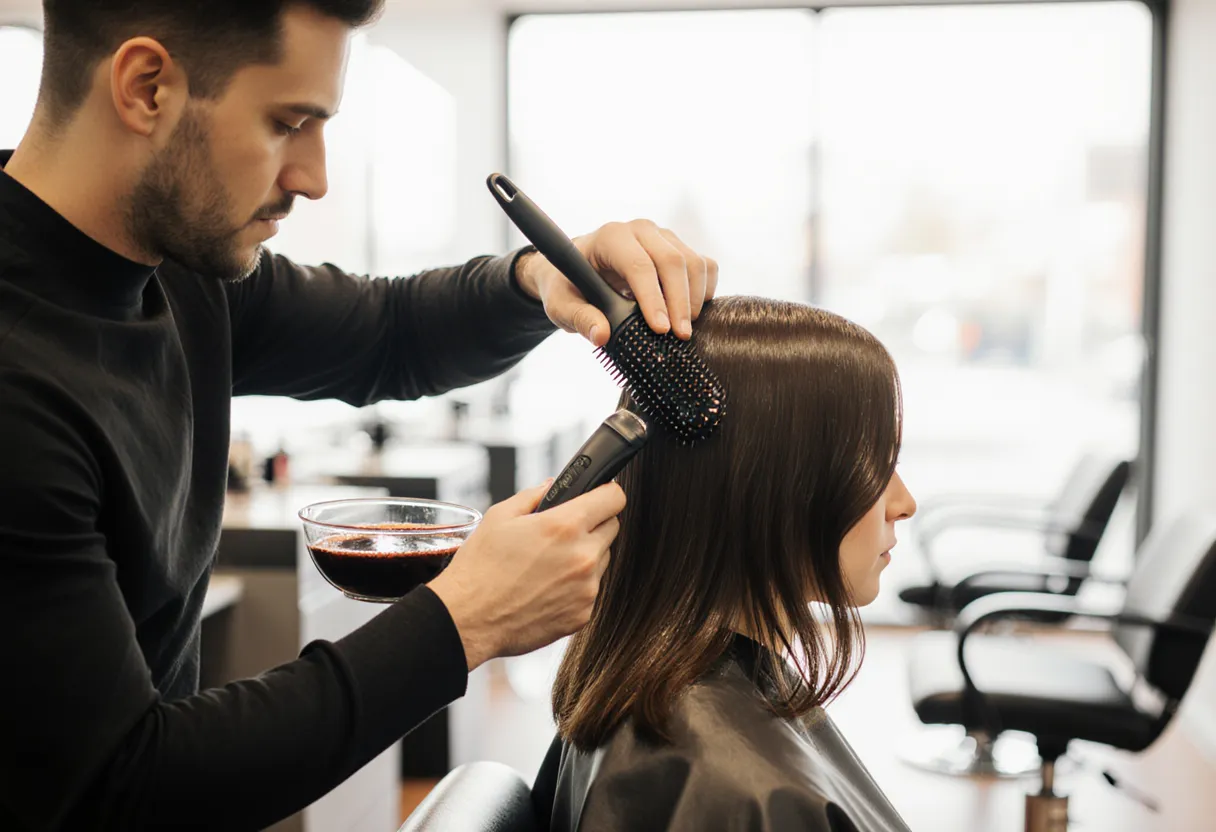
A hair gloss treatment is the fastest way we know to take hair from dull and flat to glass-shiny in under an hour. If your color has gone brassy, your ends drink the light instead of reflecting it, or your balayage just looks tired three months in, a gloss is almost always the answer — and it's gentler than most people expect.
Here's everything our stylists want you to know before you book one at our hair salon in Glendale.
What Is a Hair Gloss Treatment?
A hair gloss is a demi-permanent, low-ammonia (or ammonia-free) color service that deposits sheer tone and seals the cuticle. It doesn't lift your natural color — it only adds. Think of it as a topcoat for your hair: the shape underneath stays the same, but the finish changes completely.
Two things happen in the bowl:
- Tone. Pigment neutralizes unwanted warmth — brass, orange, yellow — or pushes your color warmer or cooler on purpose.
- Shine. The acidic formula smooths the cuticle flat, so light bounces off the surface in one direction instead of scattering. That's the mirror effect.
Clear hair gloss skips the pigment entirely and does only the second job. It's our go-to for clients who love their color but want shine without changing a thing.
Gloss vs. Glaze vs. Toner
These words get used interchangeably, and that's where confusion starts.
- Hair glaze usually means a non-oxidizing, surface-only shine treatment. It washes out fast — a few shampoos — and does no real depositing.
- A gloss mixes with a low-volume developer, so a small amount of pigment actually enters the cuticle. It lasts meaningfully longer.
- A toner is a gloss used with a specific corrective purpose, typically on freshly lightened blonde. Every toner is a gloss; not every gloss is a toner.
If brassiness is a recurring problem for you, our guide to hair color correction walks through when a gloss is enough and when you need something stronger.
Who Should Get a Hair Gloss Treatment?
Honestly? Almost everyone. But it's a particularly good call if you are:
- Four to eight weeks past a color appointment. Your tone has faded; your base hasn't grown out enough to warrant a full service. A gloss buys you another month or two.
- Dealing with brassy blonde or orange-toned brunette. A violet or blue-based semi permanent hair gloss cancels it out in 20 minutes.
- Blending early grays. A hair gloss for gray hair won't give you opaque coverage, but it softens the contrast beautifully and makes grays read as highlights rather than stripes.
- Natural and uncolored. Clear glossing is a color-free way to add shine and a little slip to virgin hair.
- Fighting dullness from hard water or sun. LA water and year-round sun are rough on hair. We see it constantly on clients coming in from Eagle Rock, Burbank, and Silver Lake.
The one group we'd steer elsewhere: if you want to go lighter, a gloss can't do it. Deposit-only means deposit-only. You'd need lightening first.
What Happens During a Glossing Appointment
A standalone gloss hair treatment at our Los Angeles salon runs about 30 to 45 minutes. Here's the sequence:
- Consultation under good light. We look at your hair dry, in daylight, to read the real undertone. Salon bulbs lie.
- Shampoo and towel-dry. Gloss goes on damp hair so it spreads evenly and doesn't grab.
- Formulation. Your stylist mixes shade plus a 5 or 10 volume developer. The formula is chosen for your current level, not the color you had last year.
- Application. Root-to-ends, or ends-only if your roots are fresh. Porous ends get it last — they absorb pigment faster.
- Processing, 10–20 minutes. No burn, no strong smell, no foils.
- Rinse, condition, blow-dry. You'll see the difference while it's still wet.
Can You Add It to Another Service?
Yes, and that's usually how it happens. We finish nearly every balayage, highlight, and single-process appointment with a gloss — it's what makes fresh color look expensive instead of raw.
How Long Does a Hair Gloss Last?
Expect four to six weeks, or roughly 15 to 25 shampoos. Variables that shorten it:
- Hot water — the single biggest culprit. Rinse cool.
- Washing daily. Every wash takes a little pigment with it.
- Clarifying and anti-dandruff shampoos. Both strip deposit fast.
- High porosity hair. Damaged cuticles hold pigment poorly. Bond or protein work first makes a gloss last noticeably longer.
- Chlorine and sun. Both oxidize tone.
To stretch it: wash two or three times a week with a sulfate-free, color-safe shampoo, use heat protectant, and ask us for a tinted conditioner matched to your gloss.
Does a Hair Gloss Damage Hair?
No — and this is the question we get most. A gloss uses a developer in the 5–10 volume range, far below the 20–40 volume used to lift color. It doesn't break down your natural pigment or swell the cuticle significantly.
What you'll usually notice afterward is hair that feels better: smoother to the touch, less tangly, with more slip through the mid-lengths. That's the flattened cuticle doing its job. The acidic pH of most gloss formulas also helps close the cuticle after an alkaline service, which is part of why we like finishing lightening appointments with one.
The caveat: repeated dark glosses build up over time and can make hair look flat or muddy. That's a formulation issue, not a damage issue, and it's avoidable with a stylist who's tracking your history.
Frequently Asked Questions
What is a hair gloss treatment, in one sentence? It's a demi-permanent salon service that deposits sheer tone and seals the cuticle, giving hair richer color and high shine without lifting or lightening.
How much does a hair gloss cost? Pricing depends on hair length and whether it's standalone or added to a color service. Add-on glossing is considerably less than a standalone appointment — ask when you book.
Does hair gloss cover gray? It blends grays rather than covering them opaquely. For full coverage you want permanent color; for softening a salt-and-pepper line, gloss is ideal and far lower commitment.
Can I gloss over highlights or balayage? Yes, and you should. Glossing is how we kill brassiness in lightened pieces and marry them to your base so the grow-out stays soft.
How soon can I gloss again? Every four to six weeks is safe. Many of our clients book a gloss between full color appointments as maintenance.
Is at-home glossing worth it? Boxed at home hair gloss can work for a light refresh, but the shade is generic and porous ends grab unevenly — which is how a subtle refresh turns into patchy ends. Professional formulation accounts for your actual porosity and level.
Book a Hair Gloss Treatment in Glendale
A gloss is the highest-impact, lowest-commitment thing you can do for your hair, and it's one of our favorite appointments to take — you leave visibly shinier than you walked in. Whether you're refreshing color, killing brass, or just want your hair to catch the light again, our stylists will formulate for your hair specifically.
We're a hair salon in Glendale, minutes from Pasadena, Burbank, and Eagle Rock. Book your hair gloss treatment and let's get your shine back.
Filed under
Written by
The Look Hair Salon
Stylist at The Look Hair Salon — bringing this story to you from our chairs in Glendale.
Ready for your next look?
Pick a stylist + time online. We'll handle the rest.
Walk-ins welcome, but online bookings get our fastest confirmation.
Keep reading
More from Hair Care Tips
 Hair Care Tips
Keratin Treatment: A Stylist's Guide
Oct 1, 2026 · 7 min
 Hair Care Tips
Head Spa Treatment: A Stylist's Guide
Sep 22, 2026 · 6 min
 Hair Care Tips
Brazilian Blowout: A Stylist's Guide
Sep 4, 2026 · 6 min
Looking for something specific? Browse every guide we’ve published.