Hair Care Tips
Keratin Treatment: A Stylist's Guide
A keratin treatment smooths frizz and cuts styling time without permanent straightening. A Glendale stylist explains the process, upkeep, and how long it lasts.
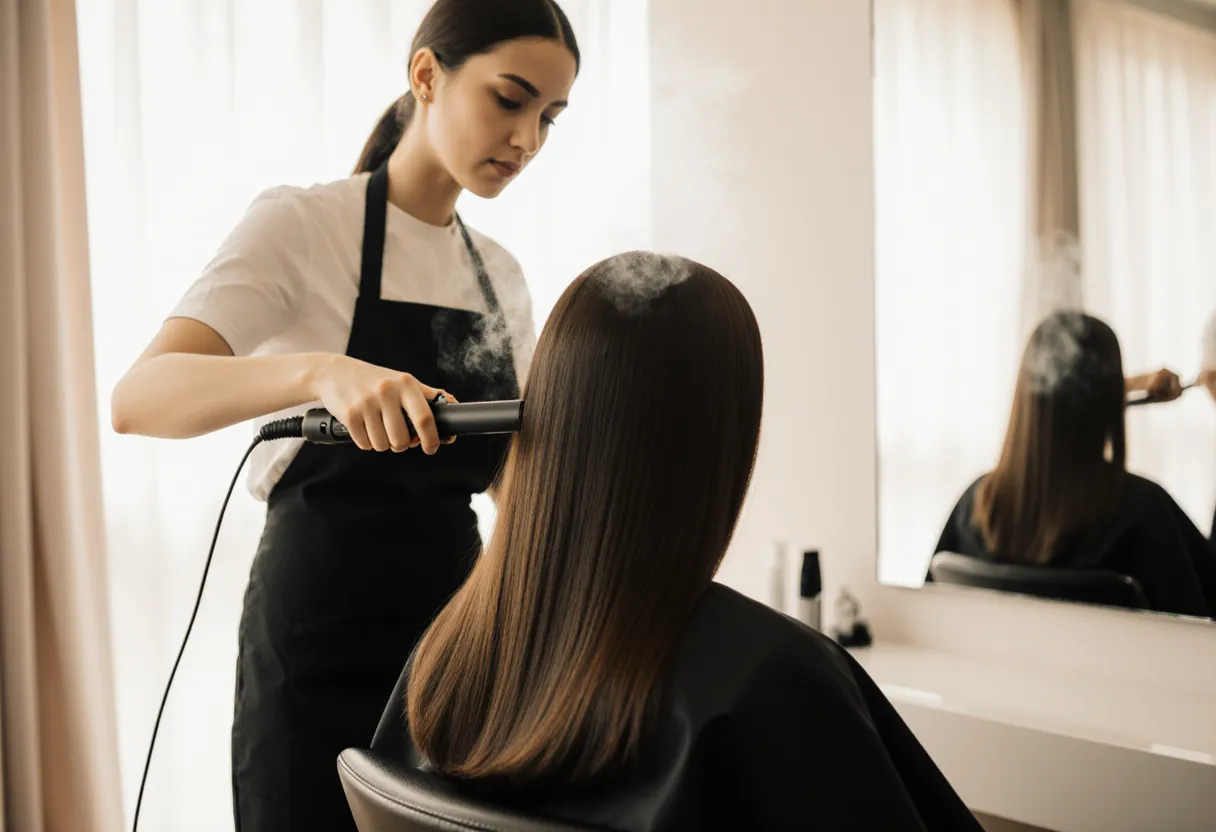
If you spend twenty minutes every morning fighting frizz and still end up with halo flyaways by lunch, a keratin treatment might be the single biggest change you can make to your routine. It's the service clients most often tell us gave them their mornings back. Here's exactly what a keratin hair treatment does, who it suits, and what to expect when you book one at our hair salon in Glendale.
What Is a Keratin Treatment?
Keratin is the protein your hair is already made of — it's the structural material in every strand. Over time, heat styling, color services, hard water, and sun exposure wear down the outer cuticle, leaving it rough and raised. Rough cuticles catch humidity, swell, and frizz.
A keratin treatment is a smoothing service in which a liquid keratin formula is applied to clean, towel-dried hair, left to absorb, then sealed into the cuticle with a flat iron at a controlled temperature. The heat bonds the formula to the hair shaft, laying the cuticle flat. The result is hair that is smoother, shinier, and dramatically more manageable — without being permanently straightened.
Keratin Treatment vs. Chemical Straightening
This is the distinction that matters most, and it's the one people get wrong.
- Keratin smoothing coats and seals the hair. It relaxes the curl pattern and kills frizz, but the hair keeps its natural shape underneath. It fades out gradually over a few months.
- Chemical straightening (like a Japanese straightener) permanently restructures the internal bonds. There's a hard line of demarcation at the regrowth, and it doesn't fade.
If you want to keep your waves but lose the frizz, you want a keratin hair treatment. If you want pin-straight hair forever, that's a different conversation — one worth having in the chair.
Who Is a Good Candidate?
A keratin smoothing treatment is a strong fit if you:
- Have frizzy, coarse, or wavy-to-curly hair that fights you in humidity
- Spend more than 20 minutes blow-drying and flat-ironing most days
- Have thick hair that feels heavy and unruly rather than fine and limp
- Want to cut heat styling time without committing to permanent straightening
- Live somewhere the weather swings — and in Los Angeles, a June-gloom morning in Silver Lake and a dry afternoon in Pasadena can be two different hair days
It's a weaker fit if your hair is very fine and already flat, since smoothing can remove the small amount of body you have. It's also not the right call on hair that's severely compromised from over-processing — in that case we'd start with a bond repair treatment and revisit smoothing once the hair can handle the heat.
What Happens During the Appointment
A proper keratin service is methodical. Here's the sequence:
- Consultation. We look at your texture, density, porosity, and color history, then choose a formula strength. A client who wants 80% of her curl gone gets a different application than one who wants frizz control only.
- Clarifying shampoo. Usually two rounds, no conditioner. This strips product buildup and minerals so the keratin can actually bind. This step is non-negotiable.
- Rough dry. Hair is blown out to about 80% dry — damp hair dilutes the formula.
- Application. The formula is applied in thin, even sections from mid-shaft to ends, kept slightly off the scalp. Even saturation is what separates a good result from a patchy one.
- Processing. Usually 20–30 minutes, depending on the system.
- Blow-dry and flat iron. The hair is dried completely and then passed through a flat iron in very thin sections — often 8 to 10 passes per section at a specific temperature. This is the step that seals everything in, and it's the step that takes the longest.
Plan on two to four hours, depending on how long and dense your hair is. Bring headphones.
How Long Does a Keratin Treatment Last?
Expect three to five months on average. A few things move that number:
- Your natural texture. Tighter curl patterns revert sooner than loose waves.
- How often you wash. Every wash is a small withdrawal from the account. Washing twice a week will stretch your results noticeably further than washing daily.
- Your shampoo. This is the big one — see below.
- Swimming. Chlorine and salt water both strip the treatment fast.
The fade is gradual and soft. Unlike chemical straightening, there's no awkward line where new growth meets treated hair, so you won't hit a point where you have to redo it.
Aftercare: How to Make It Last
What you do in the weeks after the appointment matters as much as the service itself.
- Wait before washing. Most modern systems allow washing after 24 to 72 hours — we'll tell you the exact window for the formula we use. Until then, no washing, no ponytails, no tucking hair behind your ears, no clips. Creases can set.
- Switch to a sulfate-free, sodium-chloride-free shampoo. Sulfates and salt are the fastest way to strip a keratin smoothing treatment. Check the ingredient list — "sodium chloride" hides in a lot of popular drugstore shampoos.
- Stretch your washes. Dry shampoo is your friend. Twice a week is the sweet spot.
- Cap it in the pool. Or at least wet your hair with clean water and coat it in conditioner before you get in.
- Keep heat low. You'll need far less of it now anyway — that's the point.
- Time it around color. Color should be done before the keratin service, or several weeks after. Smoothing seals the cuticle, which makes color harder to deposit evenly afterward.
Keratin and Color
You can absolutely have both. We generally color first, then smooth in the same visit or shortly after, because the keratin helps lock in tone and adds shine on top of fresh color. Smoothing can lighten a tone slightly, so your colorist may formulate a touch deeper to compensate. If you're a blonde, know that a hair smoothing treatment can shift toner — plan a gloss refresh a few weeks out.
Frequently Asked Questions
How much does a keratin treatment cost? It varies by hair length, density, and the system used, since product cost scales directly with how much hair is being treated. Longer and thicker hair takes more formula and significantly more flat-iron time. We quote exact pricing at consultation so there are no surprises.
Does a keratin treatment damage hair? Done correctly, a keratin treatment coats and smooths rather than breaking down the hair's internal structure the way a chemical relaxer does. The main risk is heat — the sealing step uses a flat iron, so a stylist who knows the right temperature for your hair's condition matters enormously. On already-compromised hair, we'd repair first and smooth later.
Will my hair be completely straight? No, and that's the point. A keratin treatment relaxes your curl pattern and eliminates frizz, but your hair keeps its natural movement. Most clients find their waves become soft and smooth rather than disappearing. If you want it straight, it will dry straight with minimal effort — but you can still wear it wavy.
How long does a keratin treatment take? Two to four hours in the chair. The flat-iron sealing step is slow by design — thin sections and multiple passes are what make the result last.
Can I get a keratin treatment on curly hair? Yes. Many of our curly clients use it as a frizz control service rather than a straightening one, choosing a lighter formula that keeps definition while removing the puff. If you want to keep your curl pattern fully intact, a curly cut and the right styling routine may serve you better — worth discussing first.
How soon can I wash my hair afterward? Depends on the system — anywhere from 24 to 72 hours. We'll give you a specific number before you leave.
Ready to Stop Fighting Your Hair?
A keratin treatment isn't about changing your hair into something else. It's about getting the version of your hair that you already like, without the daily battle to produce it. Clients come to our hair salon in Glendale from Eagle Rock, Burbank, and across Los Angeles specifically for this service, and the feedback is almost always the same: I can't believe how fast I get ready now.
If you're not sure whether smoothing is right for your texture — or whether you'd be better served by a repair treatment first — come in for a consultation and we'll give you an honest answer. Book your appointment and let's talk about what your hair actually needs.
Filed under
Written by
The Look Hair Salon
Stylist at The Look Hair Salon — bringing this story to you from our chairs in Glendale.
Ready for your next look?
Pick a stylist + time online. We'll handle the rest.
Walk-ins welcome, but online bookings get our fastest confirmation.
Keep reading
More from Hair Care Tips
 Hair Care Tips
Head Spa Treatment: A Stylist's Guide
Sep 22, 2026 · 6 min
 Hair Care Tips
Brazilian Blowout: A Stylist's Guide
Sep 4, 2026 · 6 min
 Hair Care Tips
Bond Repair Treatment: A Stylist's Guide
Sep 1, 2026 · 7 min
Looking for something specific? Browse every guide we’ve published.