Hair Care Tips
How to Get Rid of Split Ends: A Stylist's Guide
How to get rid of split ends for good — a Glendale stylist explains what causes them, why trimming is the only real fix, and how to prevent them.
How to Get Rid of Split Ends: A Stylist's Guide
If you've ever held a strand up to the window and watched it fray into two (or five) tiny forks, you already know the frustration. Learning how to get rid of split ends is one of the most common things clients ask me about in the chair at our hair salon in Glendale — usually right after they've spent months growing their hair out. Here's the honest version: split ends can't be healed, but they absolutely can be removed, prevented, and kept from wrecking your length.
What Are Split Ends, Really?
Every strand of hair is wrapped in a protective outer layer called the cuticle — think of it like the shingles on a roof, or the plastic tip on a shoelace. When that layer wears away at the tip, the inner cortex is exposed and the strand starts to unravel.
That's a split end. And because hair is not living tissue, there is no biological repair process. No mask, oil, or serum can fuse the two halves back together permanently. Anything claiming otherwise is temporarily gluing the strand shut with silicones or proteins — which is genuinely useful for appearance, but it washes out.
Types of Split Ends
Not all splits look the same, and the shape tells you what's causing the damage:
- The classic Y-split — the tip divides in two. Usually dryness plus age of the hair.
- The mini split — a shallow fork just at the very end. The easiest to catch early.
- The tree split — multiple branches off one side. A sign of significant, ongoing damage.
- The feather split — many tiny splits along the shaft. Often heat or chemical related.
- The knot or "single strand knot" — the strand loops back on itself, common on curly and coily textures.
- The white dot — a small pale speck mid-shaft where the strand is about to snap clean off.
If you're seeing tree splits and white dots, the damage has traveled up the strand and a trim is no longer optional.
What Causes Split Ends
Understanding what causes split ends is most of the battle, because prevention is the only real long-term strategy.
- Heat styling without protection. Flat irons and curling wands regularly run 400°F+. Repeated passes on the same section boil out moisture and crack the cuticle.
- Mechanical friction. Aggressive brushing, especially on wet hair, plus cotton pillowcases, tight elastics, and towel-scrubbing.
- Over-processing. Bleach, lighteners, and back-to-back chemical services lift the cuticle open. This is why I'm careful about scheduling lightening for clients who also flat-iron daily.
- Going too long between trims. The ends of shoulder-length hair are often two to three years old. They've earned their wear.
- Environmental exposure. Between the sun, dry air, and chlorine, Los Angeles is genuinely tough on ends — clients coming in from Burbank, Pasadena, and Eagle Rock all deal with the same thing.
- Dehydration in the hair itself. Hair that lacks moisture has no flexibility, and inflexible hair snaps.
How to Get Rid of Split Ends for Good
Here's the practical order of operations.
1. Cut Them Off — There's No Way Around This
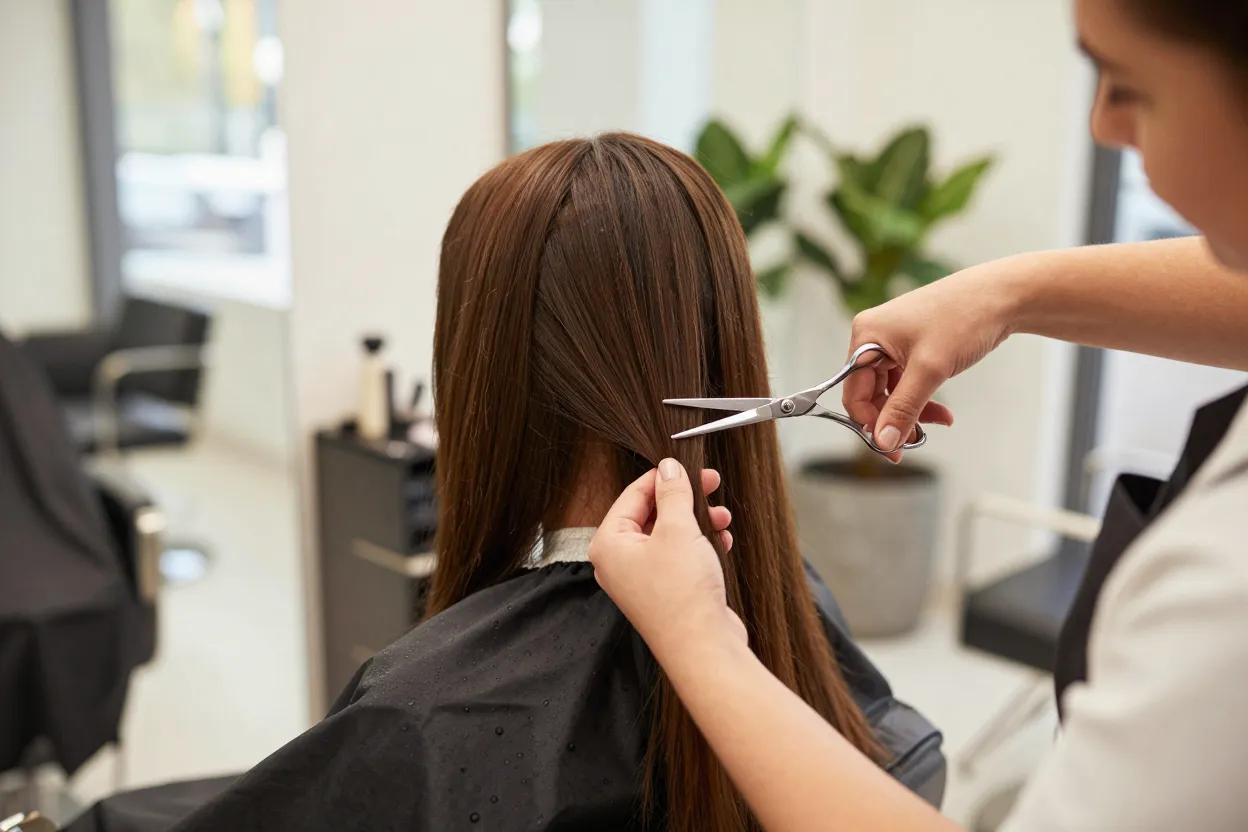
A trim is the only method that actually removes a split end. Depending on how far the damage has traveled, that might mean a quarter inch or it might mean two inches. A skilled stylist will take the minimum necessary — you don't have to sacrifice your length to fix your ends.
Ask about dusting: a technique where we remove just the frayed tips, often only 1/8 to 1/4 inch, keeping your overall shape and length intact. It's ideal if you're growing your hair out but the ends look stringy.
2. Consider a Bond-Building or Smoothing Service
While no salon service repairs an existing split, bond repair treatments strengthen the hair's internal structure so new splits form far more slowly. If your hair is color-treated, this pairs especially well with lightening appointments — I break down how it works in our guide to Olaplex bond repair treatments.
A hair gloss or smoothing treatment can also seal the cuticle down, which makes existing minor fraying far less visible between trims.
3. Fix Your Heat Routine
- Always use a heat protectant — every time, not just on "big" styling days.
- Drop your iron temperature. Fine hair rarely needs above 300°F; coarse or thick hair, 350–380°F.
- One pass per section. Multiple passes are where damage compounds.
- Take at least two heat-free days per week.
4. Rethink How You Handle Wet Hair
Wet hair stretches up to 30% more than dry hair, which makes it far more vulnerable. Squeeze water out with a microfiber towel or cotton t-shirt instead of rubbing. Detangle with a wide-tooth comb starting at the ends and working up, never from the roots down.
How to Prevent Split Ends Between Appointments
Prevention is cheaper and easier than correction. A realistic maintenance routine:
- Trim every 8–12 weeks. Fine or damaged hair leans toward 8; healthy, thicker hair can stretch to 12.
- Deep condition weekly. A moisture-based mask keeps hair flexible enough to resist snapping.
- Use a leave-in or oil on the ends only. Mid-lengths and tips need it; your scalp doesn't.
- Switch to a silk or satin pillowcase, and swap elastics for silk scrunchies or coils.
- Protect from sun and chlorine. Wet your hair with clean water before swimming and wear a hat on long days outdoors.
- Loosen your styling. Tight ponytails in the same spot every day create a consistent breakage line.
A Note on At-Home Split-End Trimmers
Those rotary trimmer gadgets do remove some frayed tips, but they can't see your hair the way a stylist can, and they frequently create blunt, uneven ends that split again quickly. If you're going to DIY, the twist-and-snip method is safer: twist a small section, snip the tips that poke out with sharp hair shears — never kitchen or craft scissors.
Frequently Asked Questions
Can split ends be repaired without cutting? No — not permanently. Bonding treatments, masks, and serums can temporarily seal the split and dramatically improve how hair looks and feels, but the only way to remove a split end is to cut above it.
How often should I trim to avoid split ends? Most people do well with a trim every 8 to 12 weeks. If you heat style daily or your hair is color-treated, aim for the shorter end of that window.
Will split ends stop my hair from growing? Hair still grows from the scalp, so growth itself isn't affected. But splits travel upward and cause breakage, so your hair breaks off as fast as it grows — which is why it feels stuck at one length.
What do split ends look like on curly hair? On curly and coily textures, split ends often show up as single-strand knots, extra frizz that doesn't respond to product, and curls that lose definition at the tips.
Is it better to get a trim or a full haircut for split ends? If damage is confined to the last inch, a trim or dusting is plenty. If you're seeing tree splits and white dots several inches up, a shaped cut will give you a much healthier result that grows out better.
Ready to Get Your Ends Back?
The fastest path to healthy-looking hair is honest advice about how much needs to come off — and a plan to keep it from happening again. Our stylists at The Look Hair Salon in Glendale will assess your ends, recommend a dusting or trim, and build a routine around your actual styling habits. We see clients from across Los Angeles, including Burbank, Pasadena, Eagle Rock, and Silver Lake.
Book your appointment and let's stop the damage where it starts.
Filed under
Written by
The Look Hair Salon
Stylist at The Look Hair Salon — bringing this story to you from our chairs in Glendale.
Ready for your next look?
Pick a stylist + time online. We'll handle the rest.
Walk-ins welcome, but online bookings get our fastest confirmation.