Color Trends
Hair Color Levels: A Stylist's Chart Guide
Hair color levels are the 1-10 scale behind every professional formula. A Glendale stylist explains the chart, how to find your level, and how many levels you can safely lift.
If you've ever brought in a photo and left with a color that looked nothing like it, hair color levels are almost certainly the reason why. Every professional formula on our shelf is built on a 1-to-10 numbering system, and once you understand it, you'll finally be able to describe exactly what you want instead of hoping we guess right. Here's the whole hair color chart, explained the way I'd explain it in my chair at our hair salon in Glendale.
What Are Hair Color Levels?
A level is simply how light or dark your hair is — nothing else. It has nothing to do with whether your hair is warm, cool, red, or ashy. That's tone, and it's a separate conversation.
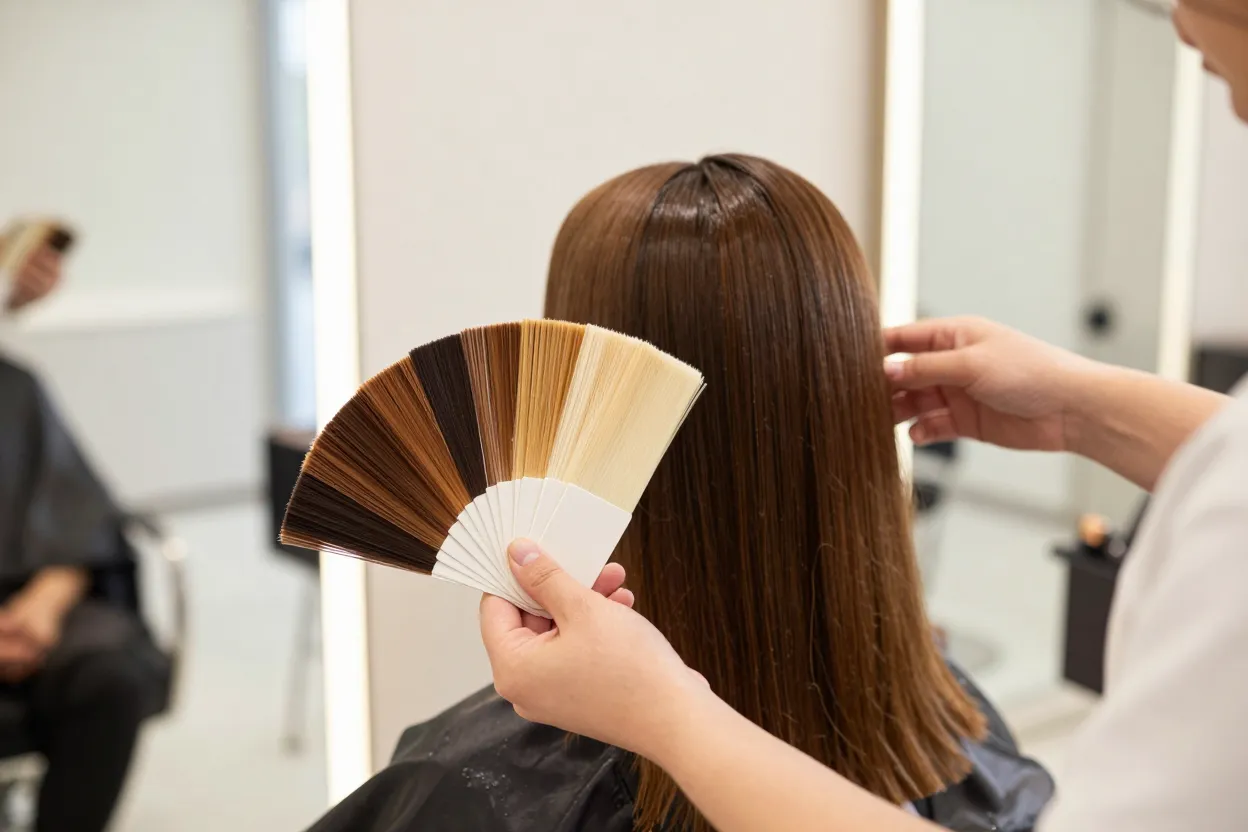
Professional hair levels run on a numbered scale:
- Level 1 — Black
- Level 2 — Darkest brown (nearly black)
- Level 3 — Dark brown
- Level 4 — Medium brown
- Level 5 — Light brown
- Level 6 — Dark blonde / lightest brown
- Level 7 — Medium blonde
- Level 8 — Light blonde
- Level 9 — Very light blonde
- Level 10 — Lightest blonde / pale platinum
Some manufacturers extend the scale to 11 or 12 for ultra-light "high lift" shades, but 1 through 10 is the industry standard you'll see on every hair color level chart.
The key thing to remember: the higher the number, the lighter the hair. A level 4 is a solid medium brown. A level 8 is a light blonde. That's it.
Why levels matter more than shade names
Brand names like "chocolate truffle" or "champagne beige" are marketing. Levels are math. When a colorist looks at your hair and says "you're sitting at a level 5 with warm undertones," we're describing a measurable starting point — and every decision after that (how much lift, which toner, how many sessions) is calculated from it.
That's also why two people can use the identical box dye and get completely different results. One started at a level 3, the other at a level 7. Same product, different canvas, different outcome.
How to Find Your Hair Color Level
You can get a solid read on your own level at home in about two minutes.
- Go to natural light. Stand by a window — not under warm bathroom bulbs, which push everything toward orange.
- Pull a section from the mid-lengths, not the roots. Root regrowth is your true natural level; ends are often lighter from sun and previous color.
- Hold it against a white towel or sheet of paper. The contrast makes the depth much easier to judge.
- Compare it to the scale above. Ask yourself one question: is this closer to coffee, caramel, or wheat?
Most clients I see in Glendale and around Los Angeles fall somewhere between a level 3 and a level 6 naturally. If you have virgin dark hair and you're wondering how you'll ever reach that pale, expensive blonde you saved on your phone, this is exactly why we talk about levels first.
Reading the second number
Look closely at a professional tube and you'll see something like 7.3 or 6/13. The first number is the level. The numbers after the decimal or slash are the tone — the reflect. Common tone codes include:
- .0 — Natural
- .1 — Ash / blue-based
- .2 — Violet / iridescent
- .3 — Gold
- .4 — Copper
- .6 — Red
So a 7.3 is a medium blonde with a gold reflect. A 6.1 is a dark ash blonde. Once you can read that, you can read any professional shade card.
The Hair Color Wheel and Why Your Blonde Turns Brassy
Here's where the hair color wheel comes in — and where most at-home color goes sideways.
Every level has natural underlying pigment that's exposed as you lift it. Dark hair isn't just dark; it's dark with a warehouse of red and orange underneath. As you lighten, you uncover that warmth in a predictable order:
- Level 1–3 → red
- Level 4–5 → red-orange
- Level 6–7 → orange
- Level 8 → yellow-orange
- Level 9–10 → pale yellow
This is why a level 4 brunette who bleaches at home lands at a brassy orange instead of a beige blonde. She didn't lift far enough, and she didn't neutralize what she exposed.
The color wheel tells us how to cancel it: violet cancels yellow, blue cancels orange, green cancels red. That's the entire logic behind toners and purple shampoo. Getting to your target level is only half the job — neutralizing the underlying pigment at that level is what makes the result look expensive instead of orange.
How Many Levels Can You Lift Safely?
A realistic rule of thumb: permanent color lifts 2 to 4 levels, depending on the developer strength and your hair's condition. Bleach can go further, but "further" always costs something.
What this means in practice:
- Level 5 → level 7? Usually one appointment. Comfortable.
- Level 4 → level 9? That's five levels. Expect two or three sessions spaced weeks apart, with bond-building treatments in between.
- Box-dyed black → blonde? Artificial pigment doesn't lift like natural pigment. This is a color correction, not a highlight.
A stylist who tells you a five-level jump happens in one sitting with no compromise is either not being straight with you or is about to compromise your hair. Slow is how blondes stay shiny.
I always pair a big lift with a conversation about tone too, because level and tone together decide whether the finished color actually flatters you. If you're not sure which direction to go, our guide to what hair color suits your skin tone walks through undertones in detail.
Using Levels to Communicate With Your Stylist
Bring photos — always. But add one sentence of level language and your consultation gets dramatically more accurate:
- "I think I'm about a level 5 and I want to end up around a level 7, cool-toned."
- "I want to stay at my level, I just want it less warm."
- "I want two levels lighter around the face only."
That last one is how you ask for face-framing brightness without committing to an all-over lift. Clients coming to us from Eagle Rock, Burbank, and Pasadena use this exact framing constantly, and it saves everyone from the "that's not what I pictured" moment.
Frequently Asked Questions
What is my hair color level? Pull a mid-length section into natural daylight and compare it against a white background. Most people land between a level 3 (dark brown) and a level 7 (medium blonde). Your unlightened root area is the most accurate read on your natural level.
What color is level 7 hair? Level 7 is a medium blonde — often called dark blonde or lightest brown depending on the brand. Its underlying pigment is orange, which is why level 7 almost always needs a toner to look clean rather than brassy.
Are hair color levels the same across all brands? The 1–10 depth scale is consistent industry-wide, but tone numbering varies between manufacturers. A ".3" is gold in most lines, but always confirm against that brand's shade chart.
Can I lift 4 levels in one appointment? Sometimes, on virgin hair in strong condition. On previously colored, fine, or compromised hair, a four-level lift is safer split across sessions with bond-repair treatments between them.
Do hair color levels apply to gray hair? Gray hair has no pigment, so it doesn't have a level of its own — but the percentage of gray absolutely changes the formula. Higher gray percentages usually need more natural (.0) base added to grab properly.
Ready to Find Your Level?
The fastest way to stop guessing is to sit in the chair and have someone read your hair in person. At our hair salon in Glendale, every color service starts with a level-and-tone consultation in natural light, so you know exactly where you're starting, where you're going, and how many visits it'll take to get there — before we mix anything.
Book your color consultation and let's map out your levels together.
Filed under
Written by
The Look Hair Salon
Stylist at The Look Hair Salon — bringing this story to you from our chairs in Glendale.
Ready for your next look?
Pick a stylist + time online. We'll handle the rest.
Walk-ins welcome, but online bookings get our fastest confirmation.